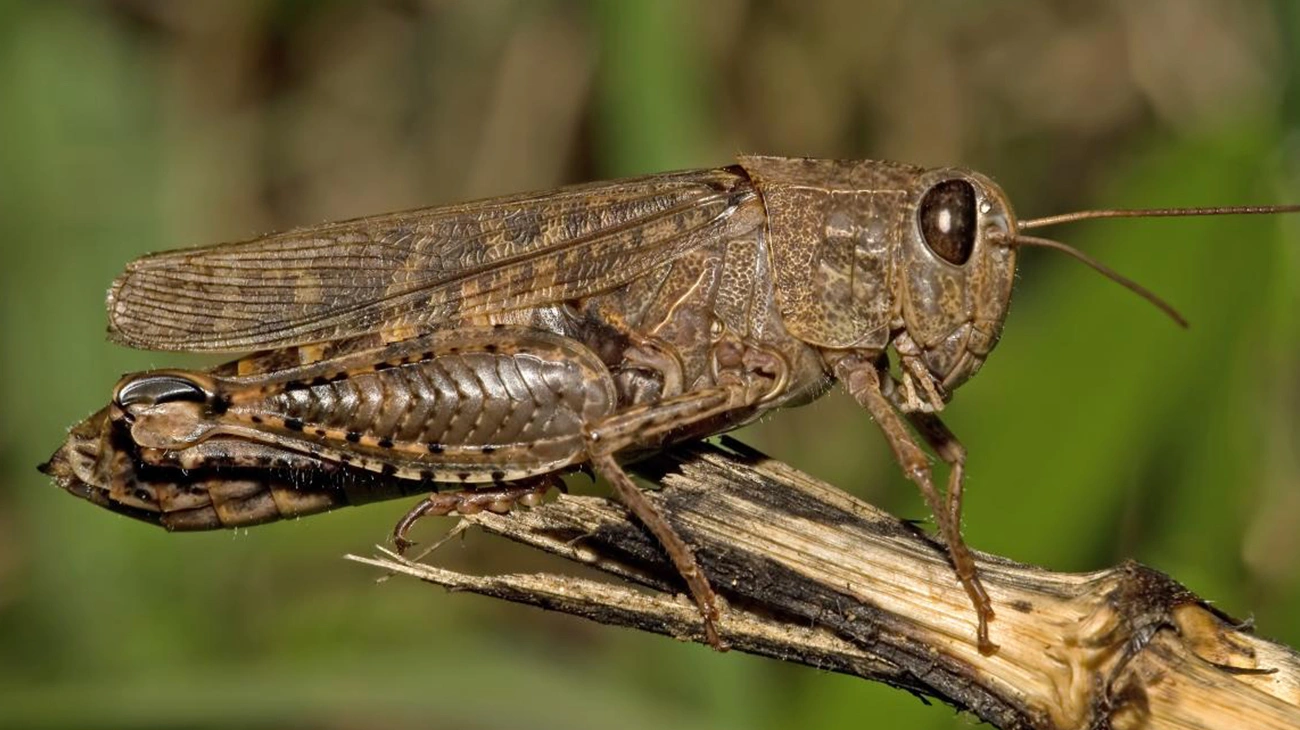
Locusts are one of the most dangerous polyphagous pests affecting agricultural crops. Under favourable weather conditions, they are capable of forming large swarms that can destroy vast areas of crops in a matter of hours. The greatest danger arises from mass locust reproduction during dry years, when the insects migrate rapidly in search of food.
Which crops do locusts damage?
Locusts feed on virtually all green plants. They most commonly damage:
- sunflowers;
- maize;
- cereal crops;
- soya;
- vegetable crops;
- perennial grasses and pastures.
Both larvae and adults voraciously feed on leaves, young shoots, inflorescences and even immature grain. When pest populations are high, crop losses can be catastrophic.
Where do locusts most commonly appear?
The primary risk areas are fields bordering natural breeding grounds for the insects:
- forest strips;
- ravines and gullies;
- meadows;
- fallow land;
- post-harvest areas with dense vegetation.
It is from these areas that locusts begin to migrate onto agricultural land, so such locations require constant monitoring.
How can locusts be controlled?
The best results are achieved not by controlling the pest after a mass outbreak, but through timely prevention.
Inspect crops regularly, especially in the morning and evening. This allows the first signs of infestation to be detected before mass spread begins.
An effective solution is the preventative treatment of field margins with insecticides based on deltamethrin, lambda-cyhalothrin or chlorpyrifos. It is precisely the treatment of field margins that often prevents locusts from penetrating into the crops.
For maize, the insecticide Nurel D can be applied at a rate of 1.5–2.0 l/ha. On sunflower crops, Karate Zeon is an effective solution at a rate of 150–200 ml/ha, in accordance with the product’s application guidelines.
If the field borders on meadows or uncultivated areas, it is advisable to begin protective measures in these areas first. They often serve as a sort of ‘bridgehead’ through which locusts enter the crops.
Additionally, green plant matter can be used as bait. To do this, the plant material is treated with an insecticide and placed on post-harvest areas or in places where the pest is concentrated.
Why is it important to work together with neighbours?
Locusts migrate easily over considerable distances, so treating just one field does not always achieve the desired result. The most effective approach is the simultaneous protection of all neighbouring farms. Coordinating actions with neighbours allows for a significant reduction in pest numbers and prevents their re-infestation.
Conclusion
In the fight against locusts, speed of response is crucial. Regular monitoring of crops, timely application of insecticides along field margins, and joint action with neighbouring farms help to localise pest outbreaks before they cause significant damage to the crop. Prevention is currently the most effective way to protect crops from the mass spread of locusts.