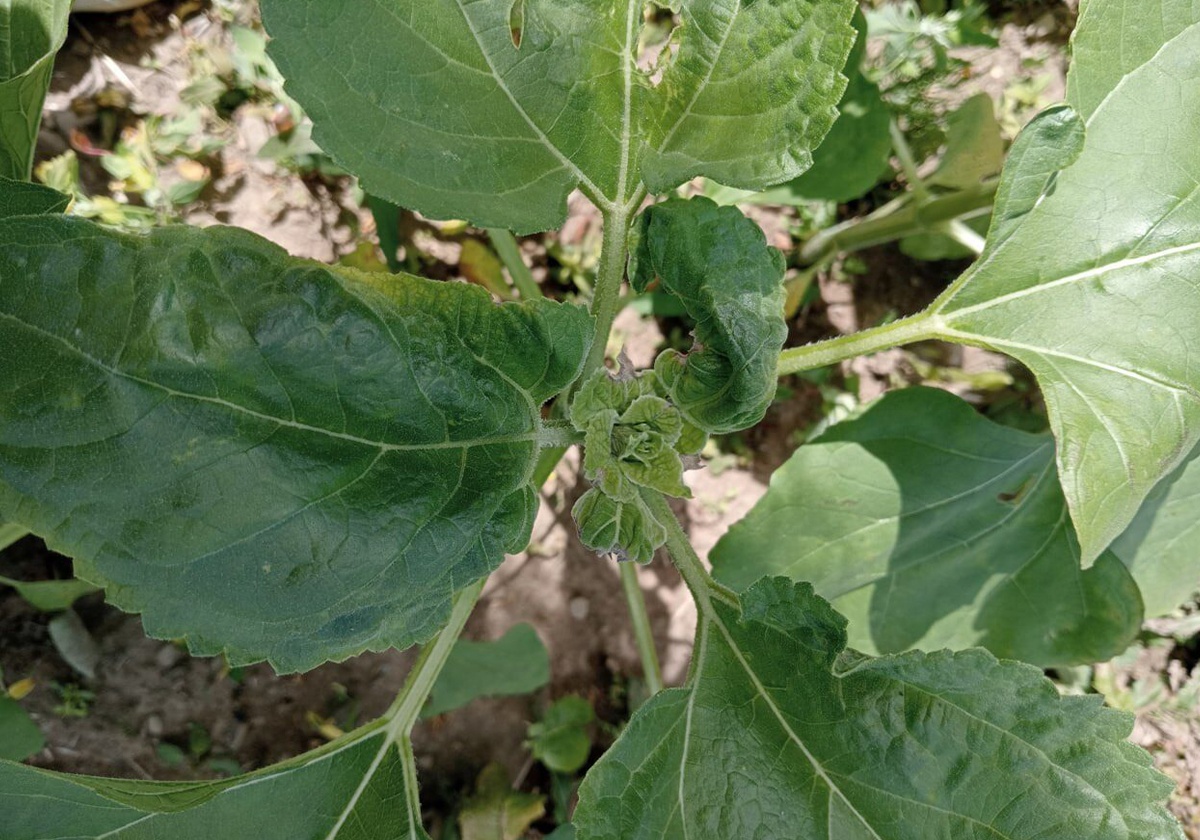
Herbicide stress in sunflowers is one of the most common causes of stunted growth following the application of plant protection products. Farmers often interpret yellowing leaves, stunted growth or plant deformation as signs of disease or nutrient deficiency. However, the cause is frequently the phytotoxicity of the herbicides themselves.
Under unfavourable conditions, even hybrids developed for Express® or Clearfield® technologies may temporarily lose their resistance to the active ingredient. If timely measures are not taken, sunflower yield losses can amount to 20–30 per cent of the field’s potential.
What is herbicide stress in sunflowers?
Herbicide stress (phytotoxicity) is a plant’s physiological response to herbicide exposure, which leads to disruptions in metabolism, photosynthesis and growth processes.
Once the active ingredient enters the plant tissues, the plant expends a significant portion of its energy not on forming the flower head or developing the root system, but on neutralising the toxic effects of the herbicide. As a result, the sunflower’s growth slows down, its leaf area decreases, and it utilises water and nutrients less efficiently.
Main causes of herbicide stress
In most cases, the problem arises not because of the herbicide itself, but due to a combination of several adverse factors.
The most common causes are:
- a sudden drop in temperature or frost following treatment;
- severe heat and a lack of moisture;
- heavy rainfall following the application of soil-applied herbicides;
- leaching of acetochlor, S-metolachlor or promethrin into the root zone;
- exceeding the recommended application rate;
- double application in overlapping areas during spraying;
- inadequate rinsing of the sprayer after previous treatments;
- use of cold or hard water to prepare the working solution;
- drift of herbicides from neighbouring fields (e.g. dicamba or 2,4-D);
- sowing a non-tolerant hybrid instead of a hybrid suitable for Express® or Clearfield® technologies.
This is why even high-quality herbicides can cause crop stress if weather conditions change drastically after treatment.
Signs of herbicide stress in sunflowers
Symptoms may vary depending on the active ingredient, but there are several characteristic signs.
The most commonly observed are:
- yellowing of the upper leaves or veins (chlorosis);
- curling, waviness and deformation of the leaf blade;
- the appearance of a purple or anthocyanin colouration on the stem;
- short internodes and stunted growth;
- the so-called ‘stunted growth effect’, where the plant shows almost no development;
- localised necrosis and burns at points of contact with the herbicide droplets.
It is important to understand that these symptoms can easily be confused with a deficiency of phosphorus, magnesium or boron, as well as with the symptoms of certain diseases. Therefore, before making a decision, it is worth considering the history of product applications and the weather conditions over the past few days.
How can herbicide stress in sunflowers be reduced?
The main mistake made by many farms is applying stress-relief agents immediately after symptoms appear. In the first few hours following treatment, this may even increase the herbicide’s penetration into the plant.
Ideally, recovery should begin 2–4 days after herbicide application, once its effects have stabilised.
To support the crop, it is recommended to use:
- plant-derived amino acids, which accelerate cell regeneration;
- humic and fulvic acids to stimulate metabolism;
- biostimulants based on seaweed extracts, containing natural phytohormones;
- complexes containing phosphorus, magnesium and zinc to stimulate the root system and restore photosynthesis.
At the same time, it is not advisable to overload the tank mix with too many components. When under stress, plants respond better to moderate and balanced nutrition. We recommend the Eurostim Premium anti-stress microfertiliser, which contains a balanced complex of micro- and macro-nutrients, amino acids, growth stimulants and biologically active components that will help your plants overcome phytotoxic stress.
How can herbicide stress be prevented?
- It is impossible to completely eliminate the risk, but it can be significantly reduced.
- To do this, you must:
- adhere to the recommended application rates;
- use only hybrids suitable for the technology;
- thoroughly rinse the sprayer;
- avoid application before a sudden cold snap or intense heat;
- monitor the quality of the water used to prepare the working solution;
- minimise overlap during spraying.
Herbicide stress in sunflowers is not a death sentence for the future harvest, provided the problem is identified in good time. Correct diagnosis, taking weather conditions into account and the timely application of anti-stress treatments help to restore the plant’s physiological processes more quickly and minimise yield losses.