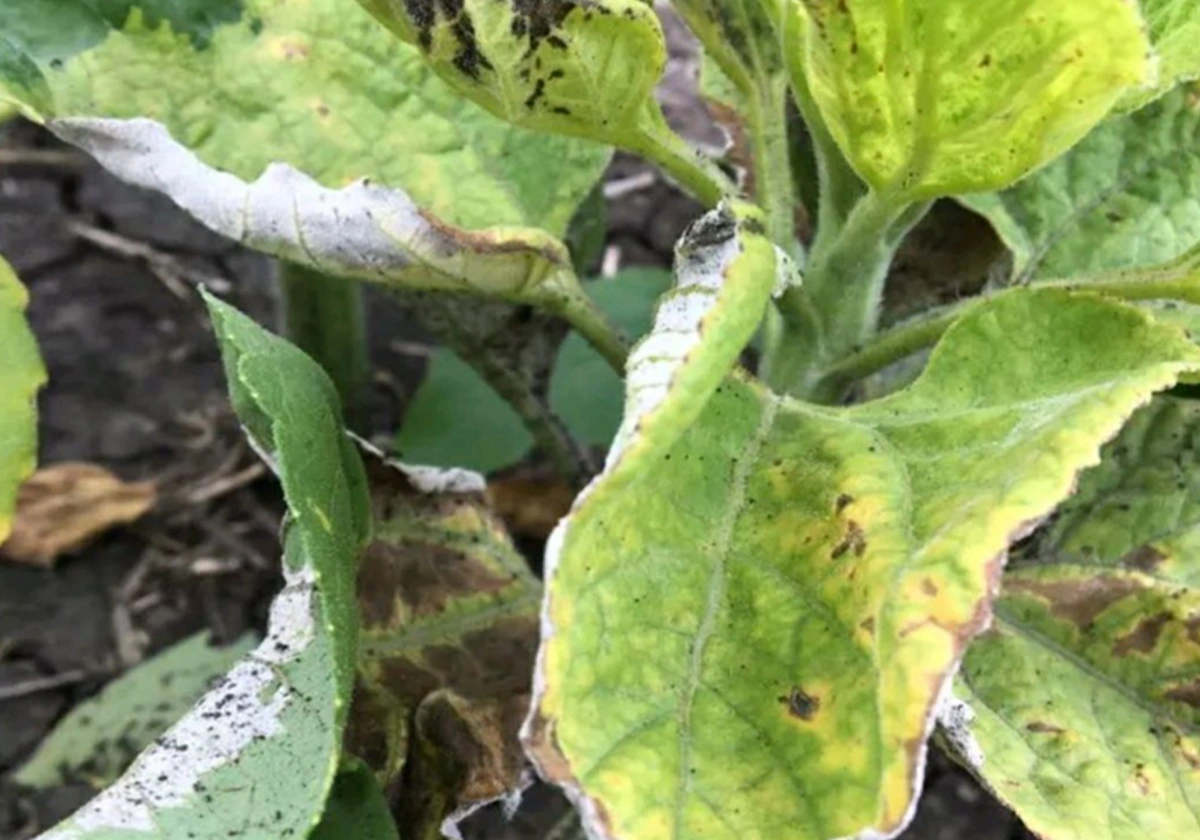
Sunflower downy mildew is a fungal disease that develops in conditions of high humidity and temperatures of 12–15 °C. Key control methods include: growing resistant hybrids, practising crop rotation, comprehensive seed treatment, using certified seed, and the timely application of fungicides. This significantly reduces the risk of crop loss and the spread of infection.
Sunflower downy mildew (peronospora) is one of the most dangerous fungal diseases affecting the crop, which can manifest throughout the entire growing season. The disease infects plants even at early stages of development, stunts growth, disrupts head formation and significantly reduces yield potential. In severe cases, yield losses can be very substantial.
What does sunflower downy mildew look like?
The first symptoms of downy mildew most often appear during the emergence stage or after the formation of several true leaves.
The main signs of the disease are:
- stunted plants;
- inhibited growth;
- shortened internodes;
- small, deformed or corrugated leaves;
- light green or yellowish stripes along the midrib;
- angular chlorotic spots on the leaves;
- a greyish-white coating on the underside of the leaf (spore production by the pathogen).
In the case of secondary (localised) infection, symptoms often appear after flowering. Some plants may show no visible signs but still act as a source of infection.
What conditions favour the development of downy mildew
The development of downy mildew on sunflowers is most intense under the following conditions:
- high soil moisture;
- high air humidity;
- temperatures of 12–15 °C;
- a cool and rainy spring;
- failure to observe crop rotation;
- frequent replanting of sunflowers in the same field.
It is precisely the combination of cool weather and excess moisture that creates optimal conditions for the pathogen’s development.
Sources of infection
The main sources of infection are:
- infected seeds;
- infected plant debris;
- infected soil;
- sunflower volunteer plants.
The pathogen’s oospores pose a particular danger, as they can persist in the soil for over six years. This is why a field may remain infected even after a long break.
How to control sunflower downy mildew
Effective protection of sunflowers against downy mildew is only possible through a comprehensive approach. If a plant has already been systemically infected, it is practically impossible to cure it completely. Therefore, the agronomist’s main task is to prevent infection.
The following preventive measures are recommended:
- grow hybrids that are resistant to peronosporosis;
- adhere to a proper crop rotation;
- use spatial isolation of crops;
- sow only certified seeds;
- apply comprehensive seed treatment;
- promptly remove volunteer plants and plant debris.
Which sunflower hybrids are resistant to downy mildew
An important component of protection is the correct choice of genetics. Eurosem sunflower hybrids with high resistance to downy mildew include:
- Grut;
- Grifon;
- S-PRO 511;
- Tor 7+ Sumo;
- Arkona Sumo;
- Stark 7+ Sumo.
The use of resistant hybrids significantly reduces the risk of disease development, even under weather conditions favourable to the pathogen.
Why seed treatment is critically important
The most effective protection against downy mildew begins even before sowing. That is why Eurosem sunflower seeds have undergone comprehensive professional seed treatment for many years.
The fungicide complex provides protection not only for the seed in the soil, but also for the young seedling for 3–4 weeks after emergence — precisely during the period when the plant is most vulnerable to infection.
The fungicide complex comprises three active ingredients:
metalaxyl-M — provides systemic protection against downy mildew;
fludioxonil — controls a broad spectrum of soil-borne pathogens;
thiram — provides reliable contact protection on the seed surface.
In addition, the seeds are treated with a clothianidin-based insecticide, a growth stimulant and a complex of micro-fertilisers, ensuring uniform emergence and a vigorous start to the crop.
Which fungicides are used against downy mildew
To protect sunflowers, products based on the following active ingredients are used:
- metalaxyl-M;
- fludioxonil;
- thiabendazole;
- thiram;
- fluazinam;
- dimetomorph;
- carbendazim;
- cyoxanil;
- myclobutanil;
- azoxystrobin;
- epoxiconazole.
The choice of a specific product depends on the crop’s growth stage, the extent of the disease, and the recommendations of the plant protection product manufacturer.
Sunflower downy mildew is a disease that is much easier to prevent than to treat. Effective protection is based on the use of resistant hybrids, adherence to crop rotation, high-quality seed treatment, control of sources of infection and regular monitoring of crops.
A comprehensive approach makes it possible to minimise the risk of peronosporosis, maintain plant health and maximise the yield potential of sunflowers, even in years with a high level of infection.