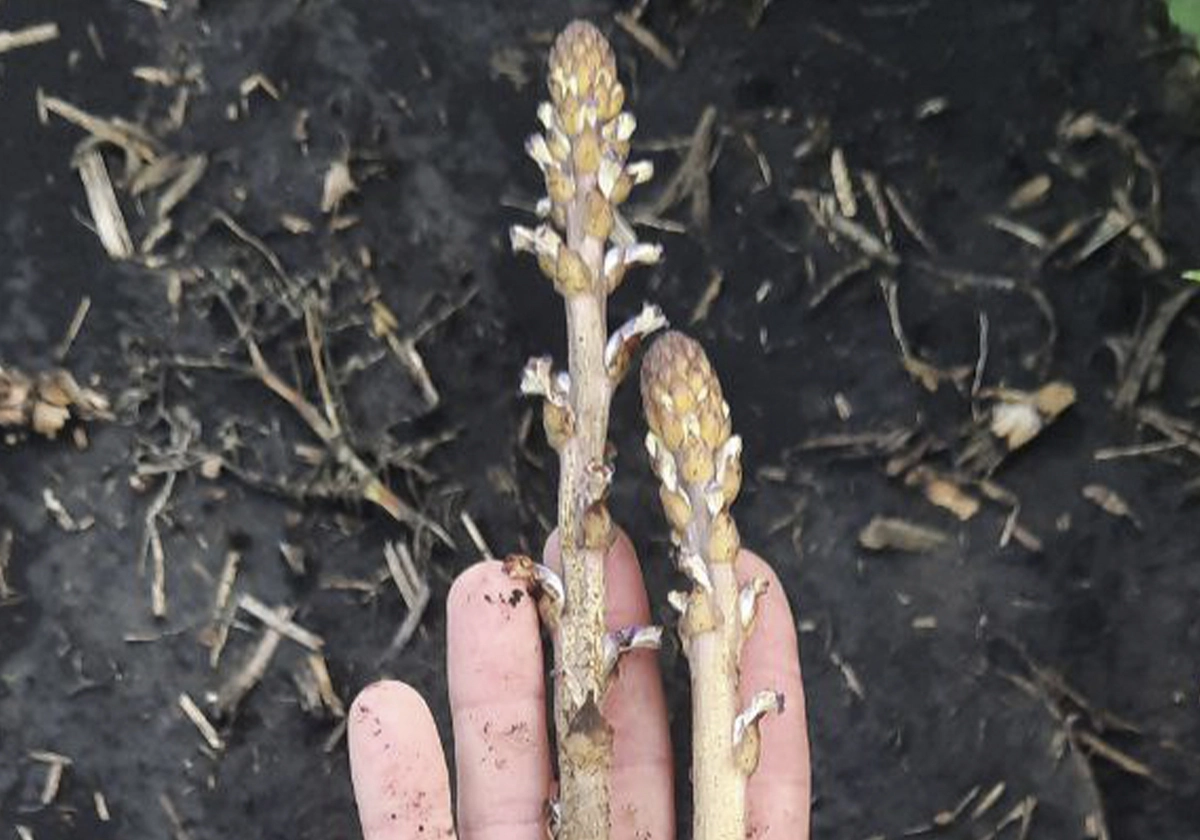
Sunflower broomrape (Orobanche cumana) remains one of the most serious challenges for sunflower growers. The parasite is capable of significantly weakening plants, taking away water and nutrients, and at a high level of damage, it can lead to significant crop losses.
One of the main problems is that the sunflower broomrape is constantly changing. Hybrids, which until recently provided effective protection against widespread races of the parasite, may eventually be affected by more aggressive populations. That is why it is necessary to constantly study sunflower broomrape populations that appear in the fields for selection and creation of new protection strategies.
Evrosem joins the international study of sunflower broomrape
The scientific division of Evrosem together with the International Sunflower Association (ISA) conducts comprehensive international research aimed at studying Orobanche cumana and finding effective strategies to control the parasite.
One of the tasks of such studies is to obtain the most representative collection of sunflower broomrape samples from different regions and crops. Of particular value are populations that were able to develop on hybrids with a high level of genetic stability.
Therefore, Evrosem is now collecting samples of the most aggressive breeds of sunflower broomrape, which have shown themselves on resistant sunflower hybrids.
What samples are we interested in?
The most interesting are the seeds of the sunflower broomrape, found on the crops of sunflower hybrids, the declared resistance of which corresponds to race 7 (G) and above.
Such cases are especially important for further laboratory study. If the parasite develops on a hybrid that has resistance to high races of sunflower broomrape, this may indicate the presence of a more aggressive parasite in the population and be of interest for the study of its virulence.
Of special scientific interest are IMI hybrids (Clearfield technology) with resistance to races 7+ (F+) of sunflower broomrape.
It is important that the sample was collected precisely from the plants of the sunflower broomrape, which are parasitic on the cultivated sunflower. Samples from carcasses are not suitable, since in this case it is impossible to reliably associate the parasite with a specific hybrid and its growing conditions.
How to properly collect a sunflower broomrape sample?
For one sample, it is necessary to collect at least 40 plants from the field. If there is an opportunity to collect more, it will only increase the value of the sample for further research.
It is necessary to remove the boxes with seeds from the plants and place them in an airtight bag. Broomrape seeds are very small and light, so during collection and transportation, they can easily fall out or mix with other material.
For secure packaging, we recommend using two zip-lock bags, placing one bag inside the other.
Special attention should be paid to where exactly the parasite grows. The tuber must be located directly in the sunflower row and be connected to the root system of the cultivated plant. Do not collect plants that grow separately from sunflowers or on carrion.
Also, it is desirable to carry out the collection no closer than 40-50 meters from the edge of the field. In the central part of the crop, it is less likely to meet a sunflower broomrape associated with carrion or other random plants.
Why is it important to provide field information?
Sunflower broomrape seeds themselves are only part of the material necessary for research. Equally important is the context in which this parasite was discovered.
Along with the sample, you must provide information about the hybrid, the region and the farm where it was collected. These data allow further linking of laboratory results with specific field conditions.
A separate sheet with the following information must be added to the sample: name of the hybrid, region, district, name of the farm, predecessor, full name and phone number, as well as the return address of Nova Poshta for receiving a gift for assistance.
The more precisely the origin of the sample is described, the more informative it will be for further work.
Where to send samples?
Samples can be sent by Nova Poshta at the expense of Evrosem:
Kyiv, NP #273
Recipient: Evrosem LLC (39007360)
Representative: +380 67 541 23 33
Do not forget to put a sheet with the necessary information about the field and your contact details before sending.
Join the study
The fight against sunflower broomrape begins not only with the selection of a resistant hybrid. To create the next generation of effective solutions, it is necessary to understand how the parasite itself is changing and which sunflower broomrape populations are already able to overcome existing resistance mechanisms.
That is why field observations of farmers are of great importance for scientific work. A sunflower broomrape found in the field can become part of an international research base and help to better understand the distribution and aggressiveness of different populations of Orobanche cumana.
If you find sunflower broomrape on a hybrid resistant to race 7 (G) and above, or on an IMI hybrid with resistance 7+ (F+), do not ignore this case.
Collect a sample, send it to Evrosem and participate in research that will help fight sunflower broomrape better in the future.
🌻 Let’s overcome the sunflower broomrape together – until he overcomes the sunflower.